
…a guest blog written by Buglife Changing Chalk Volunteer, Kirsty Lee.
This summer, whilst walking out on the chalky Downs near Brighton, I gained a superpower. I imagine some of you are rolling your eyes at this ridiculous statement or those of you with a vivid imagination might be picturing me struck by an energy bolt from above or bitten by a radioactive harvestman spider. But it was nothing like that. This power crept up on me over several days, slowly and quietly until one day, there it was, this new ability: the power of noticing.
I came by this gift whilst volunteering on the Changing Chalk project in Brighton. I had some time over summer and I wanted to do something positive for the environment instead of the usual reading and despairing I did every morning with the paper. An internet search threw up the Changing Chalk project, a partnership led by The National Trust that worked to restore and protect the rare chalk grassland of the South Downs. A keen hiker and appreciator of the views the Downs have to offer, I was nonetheless woefully ignorant of the natural systems in place that make it all so beautiful. After reaching out to the volunteer lead, I was put in touch with Alice Parfit from Buglife and that’s where the adventure started.
Alice was organising a survey of the Wart-biter Bush-cricket (Decticus verrucivorus), a keystone indicator of quality chalkland that was sadly on the edge due to the loss and fragmentation of its habitat, through over-grazing and urbanisation. The Wart-biter needs a mosaic of habitats for different stages of its lifecycle: grassy tussocks for mating, a sward rich in wildflowers and herbs that also support other invertebrates that it can eat, and bare ground/short grass for the eggs to be laid. Recording the presence of Wart-biters through surveys not only lets us know about their numbers and how well they’re doing but good numbers indicate top-notch chalkland which in turn means lots of other flora and fauna, many rare and unique to this landscape, are also being supported.
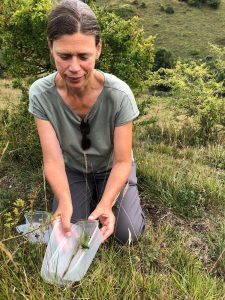
Of course when I turned up for my first day of training, I knew absolutely none of this. I had searched on YouTube and found a video of a large cricket eating a person’s wart from their finger (yes, historically, they were used for this and that is how they got their name) and listened to a video of their ‘singing’ (what I now know to be called stridulation). That was the extent of my understanding and what I went off into the Downs armed with , along with Alice and my fellow volunteers, all significantly more seasoned than I.
Surveying crickets as it turns out is ALL about the stridulation. Well, and the weather (Wart-biters prefer lots and lots of sun), and the sex (only male Wart-biters stridulate), and the time of day (they are more likely to sing early in the day. After a tiring morning of attracting females they tend to go quiet). Getting my ear in was tricky. Once you start listening you notice how many sounds there actually are on the Downs. Everyone wants to be heard! I heard Roesel’s Bush-crickets (Roeseliana roeseli) that make a long low electric buzz, a little bit like when you walk under a pylon. The Stonechat bird flitting about in the gorse, its song like two pebbles knocking together. There were also clouds of grasshoppers that hopped in front of my walking boots and stridulate by rubbing their legs against their wings, as opposed to rubbing their wings together as the crickets do. And of course lots of bees: the Large Scabious Bee (Andrena hattorfiana) and Red Bartsia Bee (Melitta trincta) for example, who prefer the pollen only from specific plants. All in all, a gentle cacophony from which I had to single out just one tiny voice.
I must stress again that at the start of the volunteering I noticed none of these things, let alone being able to name them. But the other volunteers and Alice were so generous with their knowledge, and when you’re spending a lot of time with your ear and eyes turned to the ground it’s hard not to notice the stripy spiders, a cocoon on a blade of grass, an iridescent beetle and ask, “So, what’s that?”
By the end of the first day and with everyone’s help I’d finally tuned my ear in to the Wart-biter song. To me it is a sharp, tinny sound that starts off slowly, gradually increasing speed before continuing in an extended rapid fire of beats, often for several minutes. It was so exciting to be able to hear one and correctly identify it.
Over the next few sessions, we continued the surveys. Clearly the project had been a success; we visited multiple sites and even on a cloudy day, when the sun peeped out, we’d hear the males stridulating from their kingdoms of tussocky grass.
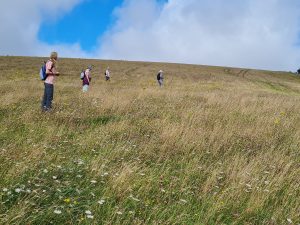
It was on my final day that I finally saw one I’d found myself. Up until that point, I had applauded my fellow team-mates’ finds but resigned myself to just not having the eagle eyes for it. Wart-biters are also masters of appearing to ‘throw their voices’ and just when I thought I was honing in on one, the song would move to the left or right of me and as I changed direction, moved back to the original spot. But this Wart-biter wanted to be seen. Clinging to the top of a piece of grass, he did not drop down as I approached and instead let me sit and watch him stridulate. He was magnificent; a bottle green colour, distinctive black marks on his wings and behind his head clearly visible, and huge dark eyes. He clung to the top, his wings vibrating and sang and sang. It was a magical moment.
The surveys are now done and Wart-biter season is over, but my new power means my walks have been changed permanently. I carry field guides and close-range binoculars, and the cracked spine of my copy of Harrap’s Wild Flowers tells its own story. The walks are slower for sure, but there is such a pleasure in the noticing and identifying.
The Changing Chalk project is also nearly over (it ends in March) but Buglife will still need to monitor the crickets’ numbers and undertake translocations to establish a new population for the next three years. I’ll be back out with Buglife next year and I’d encourage anyone with an interest in wildlife to get involved too. The work is important, not only for the Wart-biter Bush-cricket but for the wider chalk grassland it represents. And who knows — you may just discover a new superpower of your own.
If you would like to find out more & get involved with the Wart-biter project, contact our Conservation Officer Alice [email protected] or visit the project page.
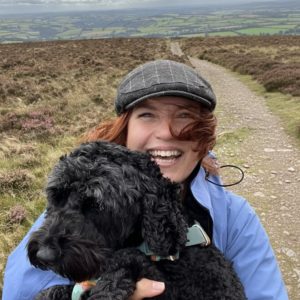
Kirsty is a Brighton-based teacher who supports children with additional needs. She finds daily inspiration in the changing colours and sea views of the South Downs, where she walks with her dog, Meg.



Main Image Credit: Wart-biter Bush-cricket (Decticus verrucivorus) © Frank Vassen (Flickr, CC BY-2.0)