
… a blog by Buglife Species Recovery Officer, Laura Krusin.
Now that summer is finally here and the sun is shining, many of us will be heading to the coast to soak up the joy of a day at the beach. Something you might notice on your beach trip is the humble driftwood. Many people may appreciate its beauty; however, its importance on our seashores runs much deeper than that; it is also a vital habitat for some of our rarest invertebrates.
Two of these rare invertebrates are the Strandline Beetle (Eurynebria complanata) and the Scaly Cricket (Psuedomogoplistes vicentae). Whilst these two species inhabit completely different parts of our coasts; the Strandline Beetle preferring sandy beaches backed by dune systems, and the Scaly Cricket residing on beaches with large shingle; these very unique species share a common need: they both rely on driftwood to survive.
Strandline Beetle
Strandline Beetles are strikingly beautiful and unmistakable in their colouring with black marks on a sand-coloured body, perfectly blending in with their habitat. In the UK, the Strandline Beetle was once found on both sides of the Bristol Channel. Worryingly, the beetle has now only been seen in South Wales in recent years, with the last English record being in North Devon in 2002! An absence of over two decades from the England’s South West coasts is cause for alarm. But what relevance does driftwood have to this beautiful and rare beetle?

Strandline Beetles are nocturnal, foraging along the strandline at night for their prey, such as sandhoppers – for example Talitrus saltator. During the day they need a place to hide from the beaks and jaws of animals that would be more than happy to munch on them as a tasty snack. In comes driftwood: the perfect refuge for a beetle seeking shelter. When the sun comes up, the beetles hide under this beach debris to protect them from predators and from the sun’s drying rays. In recent years, with a lack of driftwood and more man-made litter appearing on our beaches, beetles have had to get clever. Surveys in Wales have found the beetles under a number of unusual items including a car tire and even a Henry Hoover. This probably isn’t quite the refuge the beetles had in mind, but needs must! Whilst this may seem like a ‘benefit’ of the increasing plastic washing up on our shores, there is also a dark side for these beetles. Surveys have found beetles have become trapped inside plastic bottles and other debris. Unable to escape, the place they sought for safety can lead to their death. Driftwood and natural marine debris provide safer nooks and crannies for these beetles to hide in, protecting them from becoming another animal’s lunch.
Scaly Cricket
The Scaly Cricket is among the rarest and least well understood of our Orthoptera (Crickets and Grasshoppers) in the UK. First found in the UK in 1949, when a single female was discovered, the cricket is now known from three sites in England and two in Wales. Unusually for a cricket, it lives amongst shingle and under large stones.
The Scaly Cricket also has an interesting use for driftwood: they lay their eggs in it. Doing this requires specialist equipment. Female Scaly Crickets have incredibly long ovipositors, up to 5mm long, which considering the females body only measures up to 13mm, is incredibly impressive. This long ovipositor is a necessary tool as the female uses it to bury her eggs deep into the driftwood so that they are safe and sound, which is important, as it takes the eggs a year to hatch! By laying her eggs in driftwood, the Scaly Cricket’s offspring will be safe from predators and may even survive winter storms by staying in the driftwood and sailing the seas to a new beach should the driftwood be washed away in storm surges.
What can we do to help?
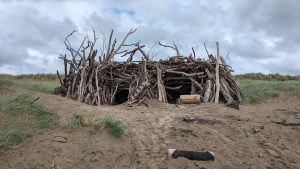
There are a number of threats to the survival of both the Strandline Beetle and Scaly Cricket, from increased storms due to the climate crisis eroding the dunes and shingle they call home, to increased development putting pressure on these fragile beach ecosystems and preventing natural processes from occurring. But one threat that we all have the power to reduce the impact of is the provision of driftwood. These charismatic species both need driftwood to survive and support the next generation. Removing driftwood for sculptures, or through mechanical beach cleaning, takes away this vital resource from the species that need it most, species that are on the brink of extinction within the UK. By leaving driftwood on the beach we can help secure a future for these two species. Burning driftwood on beaches is another real threat; not only does it remove a place for Strandline Beetles to hide from predators during the day, but any Scaly Cricket eggs present will also be burnt, preventing them from hatching into the next generation. By taking the easy action of leaving driftwood on beaches, we can help secure a future for these two rare species.
So, this summer, when out and about on Britain’s beautiful beaches, if you do spot some driftwood, spare a thought for these two incredible invertebrates, and leave the driftwood where it lies. This isn’t to dissuade you from taking part in beach cleans – removing things like rubbish, that shouldn’t be on our shores, is an important task and can have great benefits for invertebrates and other wildlife. However, by leaving the driftwood, know that you are helping to provide safe haven for some of the UK’s rarest species.
Interested in learning more about the insects that make their homes out of driftwood? Visit out Strandline Beetle and Scaly Cricket project pages.
Or have you seen the elusive Strandline Beetle whilst out and about on the English coast? We would love to hear from you! Join our Search for the Strandline Beetle.
Main Image Credit: Scaly Cricket (Psuedomogoplistes vicentae) © Alex Hyde