
…a blog written by Buglife Scotland’s Peatland Conservation Officer, Melissa Shaw.
Peatlands matter to Scotland. They cover more than a fifth of Scotland’s total land area, including the world’s largest blanket bog in the Flow Country (an area in Caithness and Sutherland widely considered the most intact area of blanket bog in the world!). Peatlands have a vital role to play in our efforts to tackle climate change and reverse biodiversity loss.
Peatlands cover 12% of the land area in the UK and the UK boasts 10-15% of the world’s entire resource of blanket bog, 60% of it in Scotland, and a quarter in England. When human activity destroys irreplaceable habitat and unnecessarily releases stored carbon it impacts “all corners” of the globe and turns a carbon sink into a carbon source.
Globally, the burning or draining of peatlands releases around two billion tonnes of CO2 per year, which accounts for up to five percent of all emissions caused by human activity. Recent research from the University of Cambridge found wildfires that burn peat too have caused up to 90% of UK fire-driven carbon emissions since 2001.
For those living near to bog, burning directly impacts the health and wellbeing of the local residents and workers with smoke from the fires directly damaging lungs and eyes.
Bog creation
Bogs are created in various ways, with blanket bogs being formed when it rains profusely on hilltops. The overwhelming excess water runs down to lowland raised bogs. Here, the water pools in an impermeable dip (such as on clay) allowing Sphagnum moss (the crucial peat building bog moss) to grow. Once these bogs have established, they grow 1mm in depth each year. Some of our deepest bogs have been growing for the last 10,000 years, making them 10 metres deep.
Once established, and when intact, our bogs store carbon and water, while at the same time filtering and slowly releasing that water back into our surroundings. They are also incredibly important places for nature – supporting a great abundance a diversity of species – including the Bog Sun-jumper spider (Heliophanus dampfi) and Large Heath butterfly (Coenonympha tullia)
For bogs to survive, they require a special type of moss called Sphagnum. Sphagnum can store up to 30 times its own weight in water. The moss is a bit of a miracle plant, as it’s also antibacterial, and was used in bandages and nappies during the World Wars.
Unfortunately, around 80% of our peatlands are degraded in some way – through peat extraction, drainage, forestry, or poor management. Degraded bogs release their carbon into the atmosphere, contributing to, rather than helping in the fight against climate change.
When “water burns”
2025 has seen one of the driest Spring seasons in 130 years in some parts of the UK; including here in Scotland. This means that our damaged and modified bogs, with their drainage ditches and peat extraction, are suffering. Where trees have been planted on top, our bogs are particularly vulnerable to fire, as they are constantly losing water out of their ditches to the trees and through evaporation from tree leaves. Drier Springs increase the risk of more vigorous and frequent fires, which in the worst cases can burn underground for days, occasionally even for years, before extinguishing.
Mean temperature – May 2025 © Crown copyright (Source: Met Office)
Rainfall – May 2025 © Crown copyright (Source: Met Office)
This underground burning creates a water repellent crust over the top of the bog and destroys vegetation cover. When burned repeatedly, as has been occurring recently at one of Buglife’s peatland restoration sites in Fannyside Muir (above Cumbernauld), it gets more difficult for vegetation to return, especially the Sphagnum. In some, admittedly rarer but no less important cases, some bog specialist plants may not come back for up to a century, with heathers, grasses and big scrubby plants establishing first, shading out, and drying out the bog further, making it more difficult for Sphagnum to re-establish.
There are a number of negative impacts associated with wildfires and burning of peat, including:
- burnt, drained, and damaged peat emits carbon;
- run-off pollution;
- flooding as the bog no longer acts like a sponge;
- air pollution directly from the fires;
- loss of biodiversity;
- loss of oxygen-producing and carbon-fixing plants .
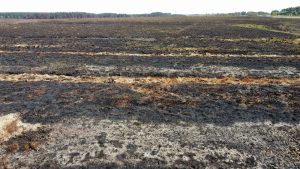
For the hub of Buglife’s peatland restoration at the Slammannan Plateau in Central Scotland, we estimate that 300 hectares of peatland have been burnt, or affected by burning patches, from this Spring’s fire alone.
The fire started on the 10 April. It has threatened livestock, with animals having to be moved to new fields, and has resulted in habitat lost for the vast majority of invertebrate species on the bogs.
Watch the IUCN UK Peatland Programme webinar on ‘Burning on Blanket Bogs: Part 1 – Effects of fire’.
So, what can be done to fix all of this?
The bogs that have been damaged by fire need time to recover. We are working with our partners to see how the fire damage can be reversed, our bogs and their wildlife restored. And we have a new project to restore more bog habitats at Easter Fannyside Muir. Over the next two years, we will be starting a new restoration project covering 110 hectares and working across three raised bogs found on the Slammannan Plateau above Cumbernauld.
There are things that we can all do to help protect our precious bog from fire. As climate change disrupts our weather and we are subjected to more hot and dry periods, it is more important than ever to be prepared, minimise the risks and prevent wildfires in all habitats, but particularly in sensitive habitats such as bogs.
We can do this by not using disposable barbeques and disposing of cigarettes and glass bottles appropriately. Do not make fires if it has been hot and dry for an extended period. If we are making fires, it is important to remain vigilant and check that they are fully extinguished (ensuring that the ground underneath leaf little etc isn’t smouldering or continuing to burn). Also, it’s vital that any fires that do start, whether purposefully or accidentally, are extinguished as quickly as possible – call 999 and ask for the Fire Service.
Other actions you can take include:
- studying the England Peat Map to learn more about peat bogs in England and discover how a similar publicly accessible map could be of benefit for Scotland;
- stopping using peat compost;
- contacting your local MP and asking about progress towards the ban on sale and extraction of peat.
Main Image Credit: Wester Fannyside Muir Burning © Melissa Shaw