
…a blog written by Buglife Scotland Species on the Edge Conservation Officer, Fiona Basford.
Tucked away in some of Scotland’s more inhospitable corners – where the soil is thin, the ground is rocky, and vegetation clings on in nutrient-poor conditions – lives a delicate insect few people have ever heard of. Measuring just a centimetre long the Bordered Brown Lacewing (Megalomus hirtus) makes its home in places most people pass by without a second glance.
The Bordered Brown Lacewing is a small, easily overlooked insect with distinctive features that make it identifiable in the field, including a notably broad costal space on the forewings and at least six branching radial veins. It’s the only species from the Megalomus genus recorded in the UK and, so far, its presence has only been confirmed in Scotland.
This lacewing is believed to be closely associated with Wood Sage (Teucrium scorodonia), which tends to grow in exposed, rocky, and nutrient-poor habitats such as slopes and undercliffs. It preys on aphids and other soft-bodied insects, and adults have been recorded between late May and mid-August.
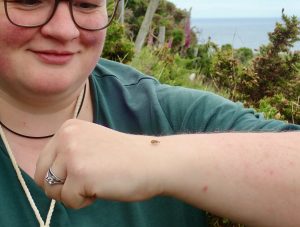
In Scotland, it has only been recorded at a handful of sites – Holyrood Park in Edinburgh, Helmsdale, and a small number of locations along the southern Aberdeenshire coast. Due to its limited and highly localised distribution, the Bordered Brown Lacewing is included in the Scottish Biodiversity List and forms part of the Species on the Edge programme.
Species on the Edge is a four-and-a-half-year partnership programme dedicated to safeguarding 37 of Scotland’s most vulnerable and threatened species found along our coasts and islands. Generously supported by the National Lottery Heritage Fund, with additional backing from NatureScot, the Esmée Fairbairn Foundation, Trekmates, and others, the programme brings together eight leading conservation organisations: Amphibian and Reptile Conservation, Bat Conservation Trust, Buglife, Bumblebee Conservation Trust, Butterfly Conservation, NatureScot, Plantlife, and RSPB Scotland.
Invertebrates on the Edge, led by Buglife, is one of nine targeted species recovery projects within the programme. It focuses on five rare and threatened invertebrates, including the elusive Bordered Brown Lacewing. The project aims to initiate recovery through hands-on conservation action, species surveys, ecological research, and long-term monitoring – deepening our understanding and giving these overlooked species a better chance to thrive.
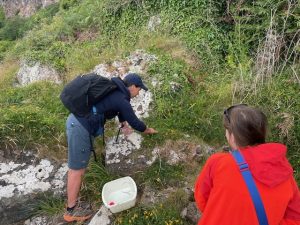
Since the project began in early 2023, several sites along the south Aberdeenshire coast between Aberdeen and Dundee have been surveyed. With support from Dr Nick Littlewood, three individuals were recorded during the first year. Survey efforts in 2024 saw increased success, with eight individuals found across four sites between Stonehaven and Aberdeen. Building on this progress, 2025 surveys have so far recorded 13 individuals, highlighting the growing understanding of the lacewing’s presence in the area.
Despite being known from only a few sites, much about the Bordered Brown Lacewing’s ecology and distribution remains unclear – making its conservation a real challenge. To address this, the “200 Hours for Lacewings” citizen science campaign invites people across Scotland to help survey and gather vital data on this species with the aim of collectively amassing 200 hours of volunteer time associated with learning, surveying and habitat management for the Bordered Brown Lacewing. By joining the effort, you can contribute to improving our understanding of its habitat needs, life cycle, and behaviour, as well as potentially discovering new sites along the coast and beyond.
All the information you need to get involved – including a detailed training video – is available on the Species on the Edge project website: speciesontheedge.co.uk/bordered-brown-lacewing. Collecting data will support a fuller assessment of the species’ conservation status and help guide practical actions to safeguard its future, especially in areas where habitat pressures such as erosion are increasing.
If you live in Scotland, and want to know how you can get involved in these surveys you can contact me at: [email protected]
Main Image Credit: Bordered Brown Lacewing (Megalomus hirtus) © Fiona Basford