
…a guest blog by James Harding-Morris, author of Endemic.
How many species are found only in Britain?
It’s a simple question, and one I assumed that someone, somewhere, must have answered before. But when I first started researching and writing about endemic species back in 2022, I realised that no such comprehensive list existed.
I gathered every reference I could find, whether buried in books, scattered across the internet, or tucked away in the minds of species experts. The result? Britain is home to over 700 species, and at least another 100 subspecies, that occur nowhere else on Earth. These are our endemics; the animals, plants, and fungi for which we bear total global responsibility.
And yet, very few people can name even a single one.
It struck me that if these are our most irreplaceable species, the ones that live or die by decisions made within our borders, then they should be at the top of our conservation priorities.
They should be celebrated, understood, and protected. And so, I set out to tell their stories, a journey that became my book, Endemic.
Our unique invertebrates
I was incredibly fortunate that at the same time I was researching endemics, Buglife’s Conservation Director, Craig Macadam, was, for the first time, compiling a report on British endemic invertebrates.
This report revealed that Britain was home to 20 species found nowhere else on Earth, made up of five species of fly, four species of beetle, two stoneflies, and one each of a woodlouse, centipede, millipede, flea, bug, bristletail, spider, shrimp and sea anemone.
I wanted to tell the stories of some of these species; to actually go out and find them, if I could. I picked five of these species to track down, but ended up bumping into a couple more along the way.
In Wales, I searched under coastal rocks for the exquisite, pearly-translucent Celtic Woodlouse (Metatrichoniscoides celticus), a tiny species, barely 2.5mm long, which was first discovered in the 1980s and is known only from Wales and the western fringes of England. Nearby, I searched damp, ferny woodlands for Chater’s Bristletail (Dilta chateri), an iridescent, alien-looking insect with astonishing jumping powers, named new to science in the 1990s.
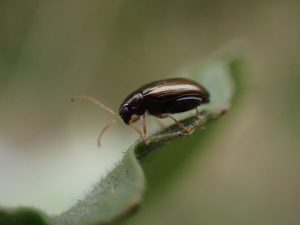
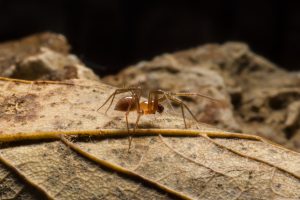
I travelled to Devon’s Lundy Island to try and see a particularly rare pairing, our only known example of co-endemism, where an endemic beetle, the Lundy Cabbage Flea Beetle (Psylliodes luridipennis) (as well as the possibly-endemic Lundy Cabbage Weevil (Ceutorhynchus contractus pallipes), currently in a state of taxonomic uncertainty) spend their lives on an endemic plant, the Lundy Cabbage. I also made a wintry visit to Plymouth in search of the elusive and threatened Horrid Ground-weaver (Nothophantes horridus), a spider found in just a few sites within the city and perpetually under pressure from development, and who owes its survival to the tireless efforts of Buglife.
Craig Macadam himself took me on a guided tour of prime Northern February Red Stonefly (Brachyptera putata) habitat in Scotland and blew my mind by showing me their musical prowess – did you know that stoneflies ‘drum’ to each other by tapping their abdomens? I even found myself slithering through tight, muddy, underground tunnels in search of my personal favourite: the blind, ghostly-pale, and utterly gorgeous British Cave Shrimp (Niphargus glenniei) which spends its life in damp rock fissures and temporary puddles in humid caves.
And finally, a chance search on the Devon coast led to the first sighting of one of our endemics for almost thirty years…
The ones we’ve lost?
When first selecting the endemics I wanted to write about in Endemic, I was immediately drawn to Ivell’s Sea Anemone (Edwardsia ivelli), a species only ever known from Widewater Lagoon in Sussex.
Unfortunately, as Craig’s report pointed out, it hasn’t been seen in over forty years and is likely extinct. It was first collected in 1973, and last seen in 1983. Within a decade of us knowing this species existed, it was gone forever. This is, sadly, not an uncommon theme with our endemic invertebrates.
The dance-fly Poecilobothrus majesticus was discovered in Essex in 1907 but hasn’t been found in over a century. The Caledonian Planthopper (Cixius caledonicus) hasn’t been seen for 70 years. I don’t think anyone has spotted the Manx Shearwater Flea (Ceratophyllus fionnus) since the 1960s, not long after it was first described; and the Turk’s Earth Centipede (Nothogeophilus turki), was first found on the Isles of Scilly and the Isle of Wight in 1988 and has never been seen again.
It’s a strange and uncomfortable truth that some of the most important species in Britain — the ones found nowhere else on the planet — are also some of the least known.
There’s something deeply unsettling about that. These species are, by definition, Britain’s sole global responsibility. If we lose them here, we lose them everywhere. And yet, despite that significance, many are slipping through the cracks, unknown to the public, rarely surveyed, barely hanging on, or already gone.
Thankfully, there are organisations fighting to change that. Buglife, in particular, has done extraordinary work in raising awareness of Britain’s rarest and most threatened invertebrates, including many endemic species that would otherwise remain entirely overlooked. From habitat protection to leading-edge research, they’ve helped put some of these forgotten creatures into the spotlight.
Endemic species are local wonders with global stakes. They’ve evolved in step with Britain’s landscapes, sometimes in isolation for thousands, even millions, of years. Unlike more familiar species we share with Europe, such as the Red Squirrel or Hedgehog, Britain’s endemics have nowhere else. No population overseas. Nowhere to reintroduce them from if we lose them. No backup. No second chances.
That’s why I wrote Endemic. It’s a celebration of the utterly unique: from mosses and woodlice to beetles and buttercups. Their stories are full of evolutionary twists, ecological intrigue and, thankfully, hope. With the right attention and action, these species can still be saved. Some have been rediscovered, others protected, and many have simply held on. Their survival is not just possible, it’s within our reach.
Endemic is out now
My book Endemic is available now from all good booksellers. It’s a journey through Britain’s most overlooked and irreplaceable species, a celebration of the species found nowhere else on Earth, and a call to recognise, cherish, and protect what makes our natural heritage uniquely ours.
About the Author
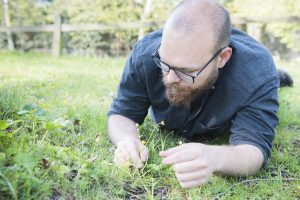
James Harding-Morris is a passionate nature enthusiast with a lifelong love for exploring the natural world. Whether trekking up mountains in search of rare flowers, scouring fens for elusive moths, or investigating exotic invertebrates in hothouses, James’s fascination with wildlife is unwavering. In his professional life, James specialises in communications and public engagement within the conservation sector. He has played a key role in delivering high-impact campaigns such as the RSPB’s Big Garden Birdwatch and the BSBI’s New Year Plant Hunt. His work on the Back from the Brink project has inspired many to care deeply about some of England’s rarest and most obscure species. Currently, James is on a mission to ensure that everyone in Britain and Ireland has the opportunity to fall in love with plants through his work with the BSBI.