
… a blog by Digital Officer, Amy Crawford.
We regularly see and read about invertebrate inspired characters in books, film and tv. They range from the endearing, like Francis the ladybird in ‘A Bug’s Life’, to the fearsome Shelob in the Lord of the Rings.
But have you ever come across their influence in folklore and myth? Join me, as we explore some of these enchanting though dark legends on All Hallow’s Eve!
The Sacred Scarab Beetle
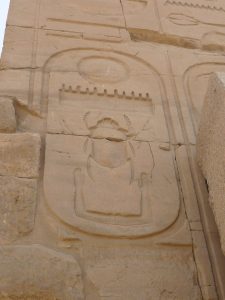
The ancient Egyptian sun god, Khepri, probably offers one of the most well-known connections between insects and gods. He is depicted in statues and iconography as having a scarab head on top of his body. Myths tell of Khepri being responsible for pushing the sun up from the underworld, across the sky in the day and then down through the underworld again as night falls, repeating the cycle over and over. This cycle and the idea behind its workings are said to have been inspired by the humble dung beetle (a member of the scarab beetle family) pushing balls of dung along the ground. I think it’s rather fantastic that something we tend to overlook was so revered by the Egyptians that it led to the creation of one of the more favoured Egyptian gods.
Khepri was also associated with rebirth, renewal and resurrection – some say the inspiration for this came from adult scarab beetles emerging from their burrows as if from nowhere, like they were self-created. We can appreciate the wonder that people would have felt seeing this spectacle, but we know now that this is a feature in their lifecycle – female scarab beetles lay their eggs in underground burrows or brood chambers with access to dung, plant material or even carrion for the larvae to feed on as they develop into adults.
The god Khepri features in the book of the dead and often scarab amulets were laid over the hearts of those undergoing mummification. The “heart scarabs” would be weighed against a feather of Ma’at (the goddess of truth and justice) during the individual’s final judgement in the underworld – deciding whether they would get to enjoy eternal life in the Field of Reeds or were to be consumed by Ammit, the devourer.
Devil’s Coach-horse (Ocypus olens)
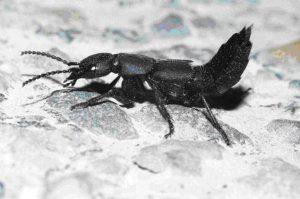
The clue is in the name as to where this tale is heading. The Devil’s Coach-horse beetle is a ferocious predator in the invertebrate kingdom. They belong to the largest family of beetles called the rove beetles, a name given as they are constantly on the move. The Devil’s Coach-horse has an intimidating defensive pose – they raise their curled abdomen in the direction of their supposed foe, not unlike the pose of a scorpion. Perhaps it is this bold and threatening spirit that cemented the Devil’s Coach-horse in myth and superstition.
As far back as the Middle Ages, this species has been associated with the Devil itself and was known in Ireland as Dar Daol which translates to ‘the Devil’s beetle’. Other names given to this beetle also include the Devil’s Footman and Devil’s Steed. It has been told that the Devil’s Coach-horse has the ability to curse a person with a point of its upraised abdomen and that it held magic powers within its small but fierce frame. In Ireland, it is said that some crop reapers (not to be confused with grim reapers) kept a Devil’s Coach-horse beetle in the handle of their scythes to improve their skill.
We have no proof of course that the Devil’s Coach-horse is in fact tangled with the Devil, but I can think of no better steed!
The Great Mosquito
The Haudenosaunee Confederacy of North America have a legend about mosquitoes and the torment that they can cause in warmer months. It begins with two giant mosquitoes that made their home along a river in Haudenosaunee country who plagued those that dared to travel by them. In an attempt to avoid deadly quarrels with the mosquitoes, the people changed their route of travel but the giant mosquitoes, who now had a taste for their prey, continued to follow them. This was a serious issue for the Haudenosaunee; they depended on waterways as a means of transportation. That was until the people formed a war party of their bravest warriors to find the giant mosquitoes and destroy them. A bloody battle was fought on the river and on land but the warrior’s relentless pursuit of the creatures that had been targeting them eventually paid off and they fell. The warriors took their war clubs to the gravely wounded bodies of the mosquitoes and struck them over and over. Then suddenly, the air filled with tiny mosquitoes that buzzed about the warrior’s ears. They had sprung from the giant mosquito’s blood and appeared to have a similar taste for blood themselves. The legend says that the continued persistence of mosquitoes is in retribution for the Haudenosaunee assault upon their ancestors.
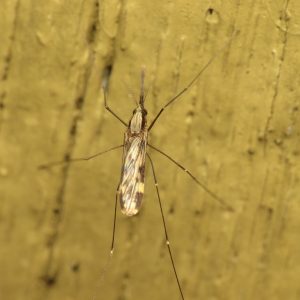
Mosquitoes are a family of small flies which groups about 3,600 species together. Both male and female mosquitoes feed on nectar and honeydew, but it is only the females of some species that have evolved to feed on blood. They hunt for hosts by smell and sight, with many of their odour receptors being found on their antennae. Some mosquitoes are significant carriers and transmitters of disease and which are passed to their hosts, including humans, when feeding. But mosquitoes and their larvae are incredibly ecologically important. As they occur in such high numbers, they are a major food source for other invertebrates, fish, birds and bats.
Their close relationship with humans has inspired many more myths than that of the Haudenosaunee. In Japanese folklore for example, there are beings known as Jiki-ketsu-gaki or blood-drinking pretas which are cursed to consume blood in atonement for past transgressions.
Buglife champion all invertebrates, including those that inspire spooky if sometimes macabre myths and legends. Learn more about why we love bugs and consider supporting our work to save the small things that run the planet!
Main Image Credit: Sacred Scarab Beetle (Scarabaeus sacer) © Podaliriy55 (WikiCommons, CC BY-SA 4.0)