
… a guest blog by Maria Giulia Checchi, Animal Behaviour graduate from the University of Exeter and Translating Science Writer for Another Way.
When we think of wasps, the first image that comes to mind is that of a black and yellow insect with a bad temper, ready to sting us as we are just trying to enjoy our lunch outdoors. In short: a true nuisance! But this idea hides a couple of biases within itself, the first being the intrinsic evil nature of the wasp. Much has already been written to defend yellowjackets from this bad reputation, so I will focus of the second: it hides the true beauty of wasp diversity.
How many wasp species are there in the UK? How many in the world? Most people could not answer this question if you asked them. Definitely no scientist could. Roughly 270 bumblebees have been discovered around the planet, together with some 160,000 moths and an estimated 1-to-2 million beetles, most of which still need to be described. But wasps? Currently, more than 100,000 species are known to science, 92,500 of which are parasitoids (more on these later!). But this number barely scratches the surface. It has been estimated that there could be between 500,000 and one million species of parasitoid wasps worldwide1. And it may turn out that there are more types of wasps than there are beetles2.
So, it’s not just a few other species that we choose to ignore when generalising wasps to a group of yellowjacket-lookalikes, but a substantial slice of our planet’s biodiversity!
Parasitoid wasps are wasps that rely on other invertebrates for reproduction, laying their eggs on, near or in their host so that they can feed on it once hatched. Insects are the single most speciose group of organisms on the planet, numbering in the millions. It should come as no surprise then that, with so much choice on the menu, parasitoids have had the chance to themself form different species over and over again and cover all the available niches. Moreover, a single host can be parasitised by different wasps at different life stages, with some targeting, for example, the larvae and some the adult of the same type of beetle.
I recently had the chance to work with one such wasp as part of a study on the evolution of eusociality and immediately fell in love with it.
Its name is the Heath Sand Wasp (Ammophila pubescens). Its narrow waist, long abdomen and big compound eyes immediately tell you which section of the field guide to open. An orange abdominal band on an otherwise black body then narrows your options down to two species: the Heath Sand Wasp and Red Banded Sand Wasp (Ammophila Sabulosa). What distinguishes them, apart from size, is their foraging behaviour. But first, let’s focus on their incredibly similar ecology.
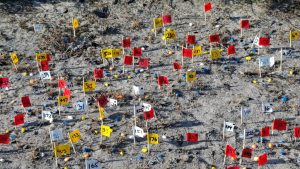
My colleagues and I spent two months handling the Heath Sand Wasp, and none of us were ever stung. Yet harmless as they are to humans, these wasps are a caterpillar’s bane! Both the Heath Sand Wasp and Red Banded Sand Wasp incubate their eggs a few centimetres underground, each in a specially dug burrow that can take up to an hour to complete. While the two pairs of hind limbs open wide on the sides of their bodies, almost crossing them with a big ‘X’, the two front legs are shorter and point forward. This allows the wasp to balance herself, for only females dig burrows, using the two hind pairs, and use their shorter front legs as shovels to move sand out of the way. And if they have a rocky start, they can either use their mandibles to remove the obstacle or, if the stone is too big, abandon the dig altogether and look for a more favourable spot.
Burrow entrances can be as close as a few millimetres to each other. Thousands and thousands crowded the narrow patch of bare sand that was our study site, and the Heath Sand Wasp had to share that space not only with Red Banded Sand Wasps, but also with Green-eyed Flower Bees (Anthophora bimaculata), Bee Wolves (Philanthus triangulum), Southern Wood Ants (Formica rufa), and Willughby’s Leafcutter Bees (Megachile willughbiella) to name a few. We could call it a Hymenoptera’s haven. Well, except for when your neighbour enters your house to lay an egg in it, or when a nosey researcher catches you to put colourful marks on your thorax, but this is a different story.
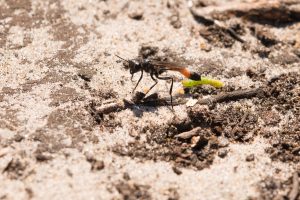
What matters is that now that the burrow is done, it’s time to provision it. And here comes the difference between these closely related species: while the Heath Sand Wasps brings back several caterpillars to feed its offspring, the Red Banded Sand Wasp decides to go big. Her size allows her to catch the juiciest caterpillars in the area, which she carries home with no lack of effort, dropping her prey and changing the way she handles it several times before making it to the burrow. Once inside she lays her egg in a matter of seconds, closes the entrance, and moves on to the next offspring. In summary: one wasp checks on her developing young often as she brings in more food, while the other does all the effort in one go. It’s rather like the difference between giving you child a weekly pocket money or dropping all the money at once in their bank account. Each strategy has its pros and cons.
More importantly, their behaviour has benefits for the wider ecosystem. Ammophila, literally the ‘sand-loving’ wasps, live in heathland and coastal areas such as sand dunes, both of which are declining habitats in the UK. By acting as a natural pest control for caterpillars, Ammophila helps to maintain the equilibrium of these habitats, and is itself controlled by larger processes. This group of parasitic wasps predate on caterpillars which allows more plants to establish, however, as more plants establish there is less nesting habitat available for the wasps. This leads to an increase in caterpillar populations and therefore fewer plants the following year, which offers more nesting habitat for the wasps – and thus, a cycle is created between the three. To oversimplify: more wasps mean more caterpillars are predated, so more plants can grow; fewer wasps mean less caterpillars are eaten and so fewer plants can grow as they are eaten by the caterpillars. Despite their demonstrated importance, parasitoid wasps are heavily understudied, and we still have a lot to learn when it comes to their exact impact on wider ecosystems.
The Heath Sand Wasp and her relative, the Red Banded Sand Wasp, are only two examples of the incredible variety of wasps. Some sport bright metallic colours like the Blue Cuckoo Wasp (Trichrysis cyanea), others make ingenious mud nests like the Heath Potter Wasp (Eumenes coarctatus), and others still give rise to abnormal growth on trees such as the Fire Gall Wasp (Diplolepis mayri). In summary: they are so much more than stereotypical picnic ruin-ers.
The next time you see something wasp-like, why not discover more about it? Buglife’s Bug Directory is a great and intuitive resource to help identify insects, and apps like iNaturalist can provide suggestions on what you are seeing once you upload a photo. Entomology communities online are also very welcoming to beginners, and a great way to learn more about wildlife.
References
- Burke, G. R., & Sharanowski, B. J. (2024). Parasitoid wasps. Current Biology, 34(10), R483-R488.
- Blackburn T. (2023) The Jewel Box. Island Press, (p. 105).
Main Image Credit: Ammophila sp. © Daniel Greenwood (iNaturalist, CC BY 4.0)